
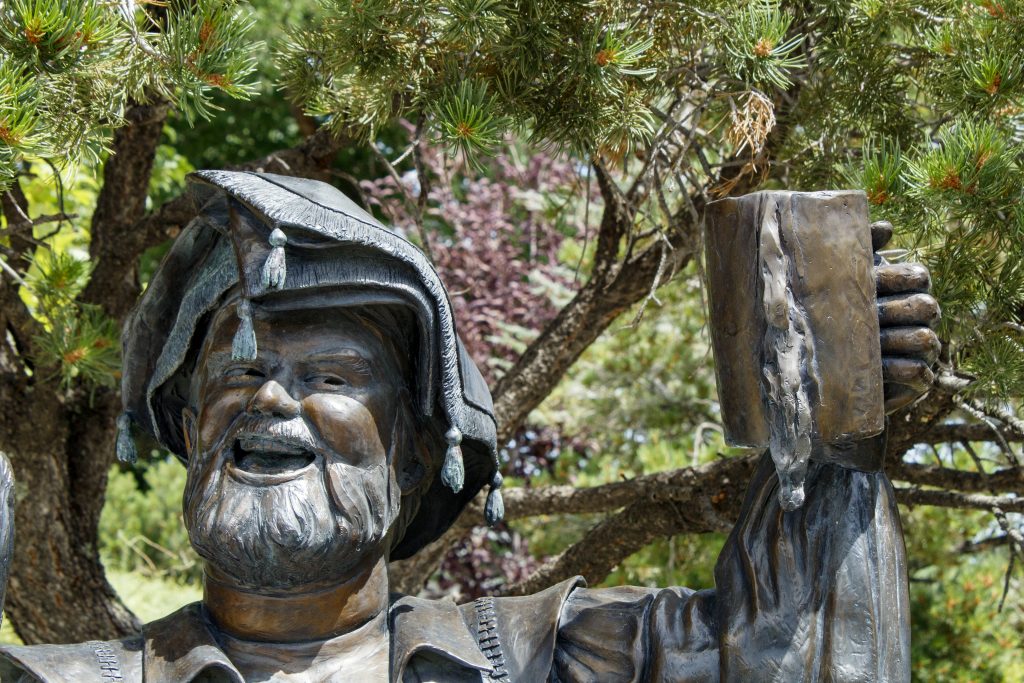
1 Falstaff – From the Script
Go thy ways, old Jack;
die when thou wilt, if manhood, good manhood, be
not forgot upon the face of the earth, then am I a
shotten herring. There live not three good men
unhanged in England; and one of them is fat and
grows old: God help the while! a bad world, I say.
Henry IV 2.4
2 Falstaff – At the Festival
The character of Sir John Falstaff first graced the Festival stage in 1965 in The Merry Wives of Windsor during their fourth season. Because the portly knight is featured in several of Shakespeare’s plays, charting his appearances at the Utah Shakespeare Festival, is a little more difficult than other the characters featured here in the Pedersen Garden. He next appeared in the 1971 production of Henry IV Part 1 then again in 1979, returning in Merry Wives. In 1981 and 82 audiences got the opportunity to see Sir John appear first in Henry IV Part 1 and then the next year in Henry IV Part 2. Though The Merry Wives of Windsor and Henry IV Part 1 continued to be produced on a fairly regular basis, the Henry IV duo was not produced sequentially again until the 2014 and 2015 summer seasons. A perennial audience favorite, Festival audiences have had the chance to see Prince Hal’s “old fat man” more than fifteen times.
3 Falstaff – Shakespeare’s Portly Knight
In Shakespeare’s history, Sir John Falstaff leads a motley group of drunken, lecherous, thieves, while taking the young crown prince Hal under his wing, treating him as one of their own. Despite their best efforts at leading the young man astray, Shakespeare’s tetralogy tells the tale of Prince Hal’s rise to becoming the skilled politician and intrepid warrior, King Henry the Fifth.Though primarily a comic figure, Sir John carries with him the kind of depth and complexity most often associated with Shakespeare’s more serious characters. Falstaff first appears in Henry IV Part One, and then returns in Henry IV Part Two, and then is eulogized in Henry V. An audience favorite since first introduced around 1597, a theatre tradition dating back centuries claims that it was Queen Elizabeth I herself who asked to see the beloved character in one more play, this time a love story, inspiring Shakespeare to write the romantic comedy, The Merry Wives of Windsor.
Artist: A. Clayton Robbins
A. Clayton Robbins was born in Alberta, Canada in 1919 but lived in Utah most of his life until his death in 2010. Though he studied under very talented mentors at the University of Utah and was involved in fine art most of his life, it wasn’t until after he retired that he truly pursued it as a full-time profession. The last 30 years of his life was devoted almost exclusively to the creation of bronze sculpture. Many of the sculptures in the Pederson Shakespeare Character Garden were created by Robbins or were fashioned on his design.